
The function of this aircraft varied somewhat with the progress of World War II. Originally conceived as a reconnaissance bomber, it was modified and adapted to perform other roles such as freighting, paratrooping, glider towing etc.
Its first flight took place on 20th March 1940 and early tests showed the need for some increase in wing area, which was quickly carried out.
| Power Plant: |
2 Bristol Hercules XI air cooled radial engines of 1,590 h.p. each with De Havilland fully feathering propellers. |
|
| Dimensions: |
Span 77 ft. Length 59 ft. 11 in. Height 15 ft. 7 in. Wing Area 803.5 sq. ft. |
|
| Weight: |
Empty: 22,600 lb. A.U.W.: 36,500 lb. |
|
|
|
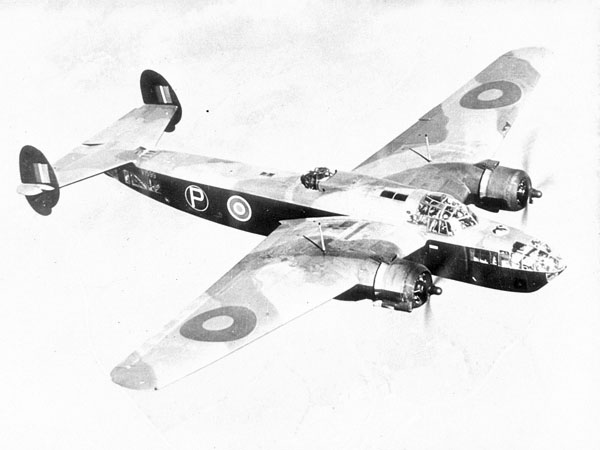
An outstanding feature of this aircraft was that it was the first to be adopted by the R.A.F. with a tricycle undercarriage.
Another was that the structure throughout was devoid of light alloy, being of steel and wood. This policy was based on the premise that supplies of light alloy would be short.
An interesting aspect of the construction was that every major component was broken down into sub-assemblies for quantity production by sub-contractors, these numbering well over 1000 and were greatly varied in character. Aircraft assembly and flight test was done at A.W. Hawksley Ltd. factory at Brockworth, Gloucestershire.
Performance:
Max. Speed: 250 mph. at 10,500 ft.
Normal Range: 1,300 miles.
Armament:
Bomber version had a Boulton & Paul 4 gun dorsal turret.
Bomb Bay in fuselage.